
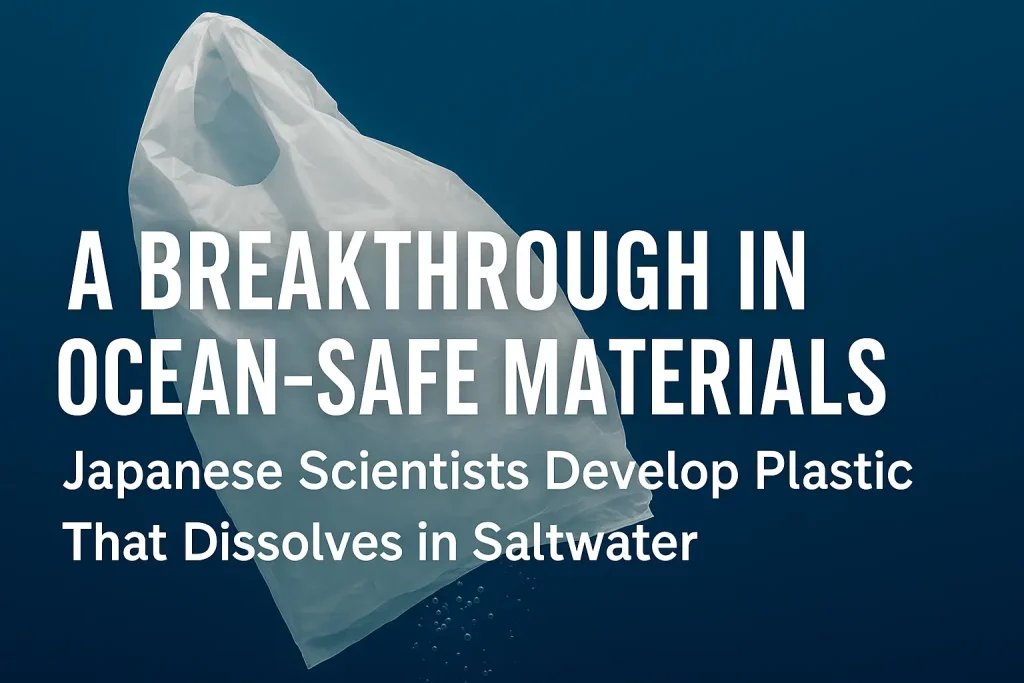
In a groundbreaking development that offers new hope in the global battle against ocean pollution, scientists in Japan have engineered a novel type of plastic that dissolves in saltwater—leaving behind no harmful residue.
At the heart of this discovery is the team led by Professor Takuzo Aida at the RIKEN Center for Emergent Matter Science (CEMS), a renowned research institution in Japan. The team has created what’s known as a supramolecular plastic—a polymer that holds its form and strength during everyday use but rapidly breaks down into harmless, biodegradable components when exposed to seawater.
Why This Matters
Plastic pollution has long been one of the greatest threats to marine ecosystems. Traditional plastics, formed with stable covalent bonds, persist for decades in the environment. When they fragment, they create microplastics—tiny, nearly invisible particles that harm marine life, disrupt food chains, and eventually find their way into human bodies.
This new material, however, changes that equation. The RIKEN team’s innovation uses reversible ionic bonds to hold the plastic’s structure—strong enough for regular use, but uniquely vulnerable to the electrolyte-rich environment of seawater. Once immersed in saltwater, the material dissolves within hours.
How It Works
The material is formed using two monomers:
- Sodium hexametaphosphate, a common food additive
- Guanidinium-based monomers, which are organic compounds that form cross-linked salt bridges
When mixed in water, these components naturally separate into two layers: one watery and one thick and viscous. The latter contains the essential salt-bridged polymer. By isolating and drying this viscous phase—a process known as desalting—the scientists produced a durable, flexible plastic called alkyl SP2.
Importantly, the final product is strong and stable in freshwater or dry conditions, but when submerged in saltwater, it quickly breaks down into simple, biodegradable molecules that bacteria can easily metabolize. This ensures it doesn’t persist in the environment or contribute to microplastic pollution.
A New Horizon for Environmental Innovation
The implications of this innovation are immense. If scaled and adopted globally, saltwater-dissolvable plastics could replace conventional plastics used in marine-bound products like fishing gear, packaging for coastal transport, or even single-use plastics in seafaring communities.
EcoServants® sees this as a promising step toward aligning innovation with ecological stewardship. It reflects our mission to support technologies that protect the planet’s delicate systems—especially our oceans, which are vital to climate regulation and biodiversity.
As nations consider alternatives to traditional plastics, solutions like this supramolecular plastic offer a model for how science can design with nature in mind, not against it.
🌊 Ready to be part of the solution?
Support EcoServants’ work in marine restoration, education, and sustainable innovation.
🔗 Volunteer with us
💚 Donate to support our mission