

EcoServants Environmental Reporting
El Niño has become synonymous with the growing climate crisis of the modern age, almost like a meteorological boogeyman. What’s less understood is that the effects of El Niño are less about the event itself and more on how it’s intertwined with human activity.
El Niño is a natural warming of the Pacific Ocean that occurs every two to seven years, a way for the Earth to circulate heat. It’s not to be confused with La Niña, which is a cooling of the Pacific Ocean. With the latest La Niña pattern dying down, the signs of El Niño are being seen. As explained by Alexandra Witze, a science journalist, “In the past few months, sea surface temperatures in parts of the tropical Pacific Ocean have warmed more than usual, which is the hallmark of an emerging El Niño.”
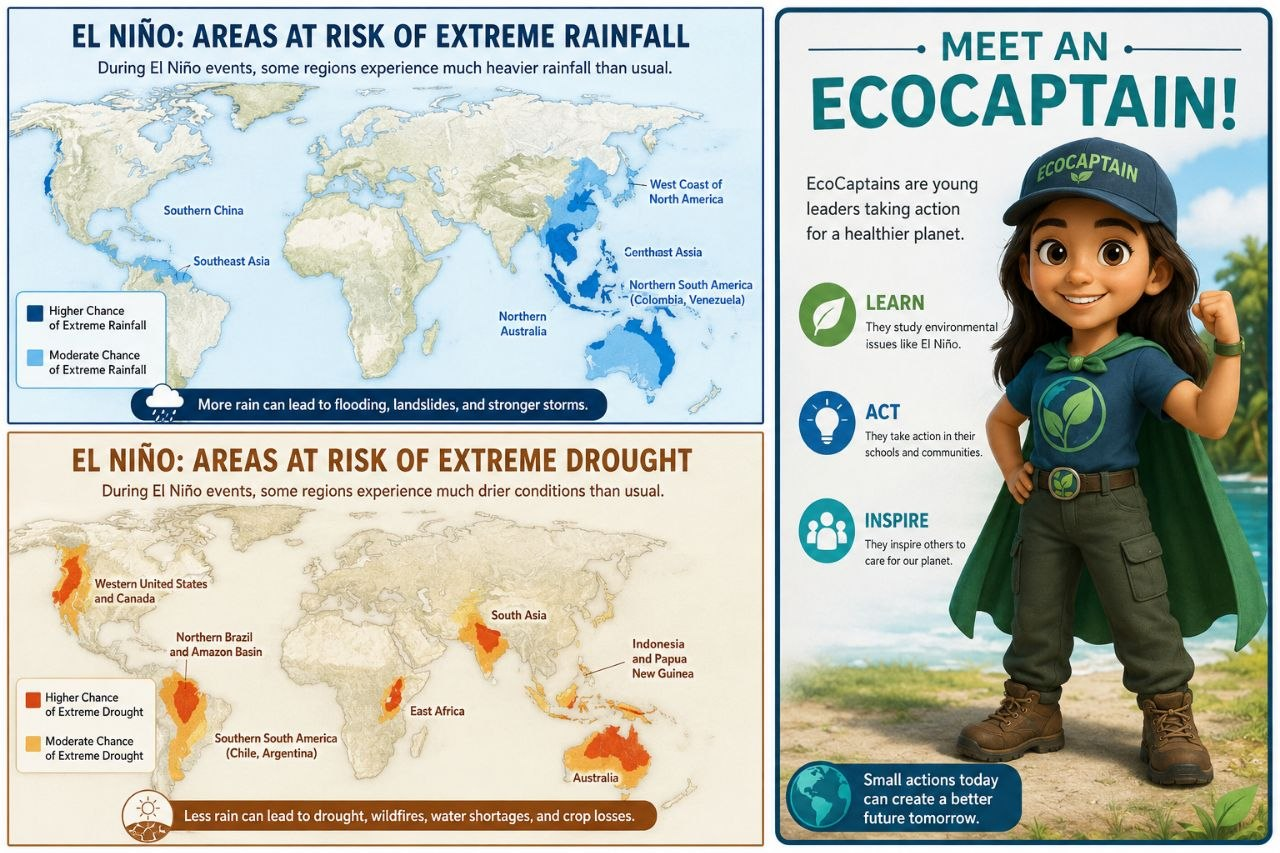
Whenever an El Niño event occurs, there are two kinds of disasters: extreme or absent rainfall. Forecasters are predicting the effects of this year’s El Niño may be the most devastating yet. As the BBC reports, “A new phase of the natural El Niño weather pattern could begin in a matter of weeks, the UN has warned, boosting temperatures on a planet already under strain from climate change.”
What Is Known and Unknown
Predicting anything about El Niño is difficult in the spring, as it is when the Northern Hemisphere is least cooperative with prediction models.
However, the probabilities that have been calculated almost guarantee an El Niño event. For example, the World Meteorological Organization, a subdivision of the UN, released a report saying that an El Niño event in 2026 is 90% likely. Meanwhile, a paper published in the journal Ocean-Land-Atmosphere Research predicts an El Niño event in the next six to nine months.
What’s most alarming about these predictions is the possibility of a “super El Niño.” This isn’t an official term in classification systems, but it is understood as an El Niño with an unprecedented amount of strength.
This super El Niño is one where the ocean temperature rises to 2 degrees Celsius or above, creating the strongest kind of El Niño possible. Current predictions only have a super El Niño at 37%, a small but notable possibility.
There is also the possibility that El Niño’s strength could be tempered by winds. According to Emily Becker, a climate scientist at the University of Miami in Florida, winds in the Pacific Ocean can weaken El Niño waters by cooling them, but this is not guaranteed.
Why This Is Concerning
As explained by the WMO, climate change does not have a direct effect on El Niño patterns, “But it can amplify associated impacts because a warmer ocean and atmosphere increases the availability of energy and moisture for extreme weather events such as heatwaves and heavy rainfall.”
In other words, the places that receive extreme rainfall, such as the southern United States and parts of South America, will receive worse rainfall. Meanwhile, the places that receive drought, such as Central America and Australia, will receive worse droughts.
A super El Niño event is the worst-case scenario, as that is enough to cause wildfires in the drier places and floods in the wetter places. The effects can be long lasting, according to climate scientist Jong-Seong Kug from Seoul National University. He and his colleagues predict lasting shifts in climates and ecosystems following a super El Niño.
Even if an El Niño event falls short of “super,” the effects would still be damaging. This is because the planet is hotter than ever from climate change, allowing El Niño to wreak extra damage.
It’s not just the environment that’s in danger of El Niño, but also the economy as well. As explained by the BBC, “Past events have been linked to spikes in food prices and hundreds of billions or even trillions of dollars in lost income globally, as crop failures and trade disruptions ripple through supply chains and economies.” To put it simply, humans are paying the price for El Niño.
The Big Takeaway
One thing is abundantly clear: human activity is making the world less resistant to El Niños, and it’s because of human-caused climate change. With this year’s El Niño season, there is a chance that the impact could be exceptionally high.
The biggest thing that can save nature and communities from future El Niños is weakening dependence on fossil fuels. UN Secretary-General António Guterres said it best when he declared, “The only effective response is climate action equal to the crisis – ending the addiction to fossil fuels, accelerating the shift to renewables, protecting the most vulnerable, and delivering early warning systems for all.”
This may sound like a daunting task, and most people wouldn’t know where to start. Fortunately, there is a first step that EcoServants can help with: people can educate themselves on the issue.
The WMO plans to monitor weather patterns so that governments, humanitarian organizations, and communities can be given warnings in advance. Knowledge will be the thing that protects people from the prospect of a super El Niño.
EcoServants provides a variety of options for spreading knowledge across communities. People can sign up to become Eco-Captains to serve as examples for their communities. In this role, Eco-Captains promote environmental awareness and motivate others to protect the planet from events like El Niño.
Alternatively, people can sign up for one of the many programs that EcoServants provides. Whether it’s working as a volunteer intern or serving as an Earth Steward for EcoSprouts, people can gain the skills and experience to become a benevolent force for the planet.
Climate change and the way it supercharges El Niño is a complicated issue that involves communities across the globe. As such, there are no easy solutions. However, with stronger El Niños in the foreseeable future, inaction is not an option.
People need to take responsibility for their impact on the planet and make change now. Only then will El Niño be more forgiving to the people it shares a planet with.
Get Involved with EcoServants
EcoServants helps communities learn, organize, and take practical environmental action. Become an Eco-Captain, volunteer intern, or Earth Steward to help protect communities from climate-related impacts.
Explore EcoServants Opportunities